

The Night Before
For anyone in town early, we’re gathering at Validation Ale the evening before the wedding. Nothing formal, no dress code, entirely optional. Stop in for an hour or stay the whole time, and food and drinks are available for purchase.
Validation is a brewery and taproom in the Funk Zone, a few blocks off the waterfront, serving pizza and sandwiches alongside their own beer. The taproom’s most-ordered pours get “validated” and earn a permanent tap, so the board shifts with whatever the room has been drinking. Much of the seating is outside, so bring a sweatshirt or a jacket — Santa Barbara cools off quickly once the sun drops.
Sunken Garden
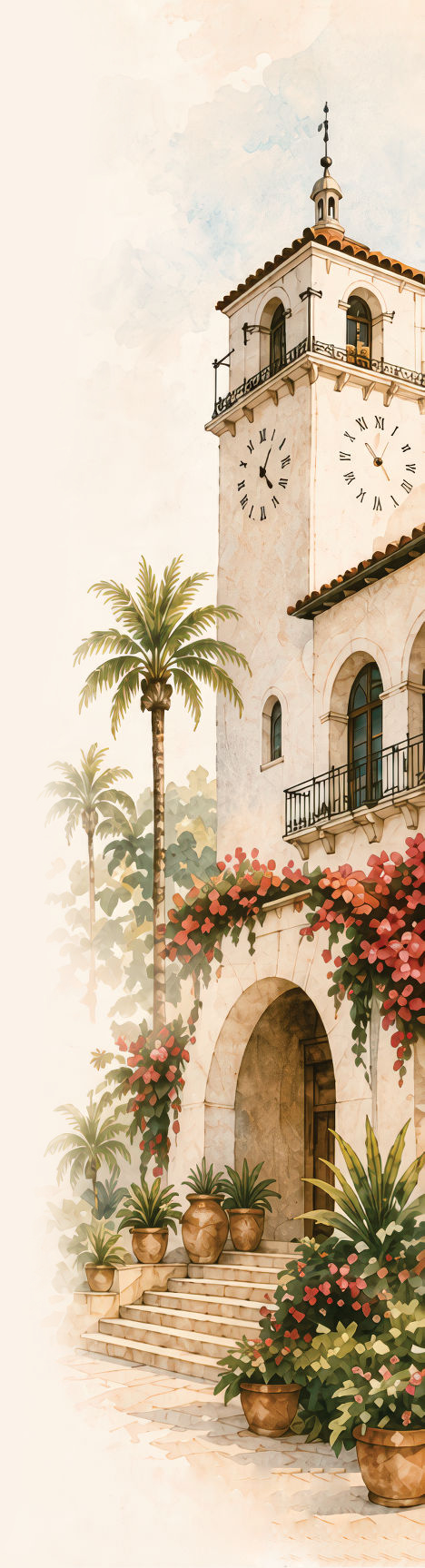
The Santa Barbara County Courthouse is one of the city’s most beloved landmarks, completed in 1929 after the 1925 earthquake reshaped much of downtown Santa Barbara. Designed in the Spanish-Moorish / Spanish Colonial Revival style, the courthouse reflects the city’s signature red-tile roofs, graceful arches, hand-painted details, and romantic old-world character. It is still a working courthouse today, which makes it feel less like a preserved relic and more like a living part of Santa Barbara’s history.
Rising above the courthouse is the Clock Tower, also known as El Mirador, one of the best viewpoints in Santa Barbara. Inside the tower is a historic 1929 Seth Thomas tower clock, still part of the building’s charm, along with the Bisno Schall Clock Gallery, which celebrates the history of timekeeping. From the top, guests can see the red-tiled rooftops of downtown, the Santa Ynez Mountains, and the Pacific beyond.
The Sunken Garden, where we’ll celebrate, sits on the site of the original 1872 courthouse. After the earthquake, the space was transformed into a lush garden surrounded by the courthouse’s architecture, palms, lawns, and stone details. Over the years, it has become one of Santa Barbara’s most iconic gathering places for civic events, performances, and weddings: a pretty fitting place to start our next chapter.
Cabrillo Pavilion
The Cabrillo Pavilion is one of Santa Barbara’s classic beachfront landmarks, built in 1926 shortly after the 1925 earthquake helped reshape the city’s architectural identity. Designed by Roland Sauter and E. Keith Lockard, the Pavilion reflects the Spanish Colonial Revival style that Santa Barbara is known for: white stucco walls, terra-cotta rooflines, arched details, and a graceful seaside presence along East Beach.
The building exists largely because of local philanthropist David Gray, who funded it and donated it to the City of Santa Barbara in 1927. Gray intended the Pavilion to serve the public, with two lasting conditions: that it remain self-sustaining and continue to support parks and recreation. Over the decades, it has served many roles, including a beach bathhouse, dance hall, community gathering place, arts center, event venue, and recreational facility.
Today, the Cabrillo Pavilion remains a beloved piece of Santa Barbara’s waterfront history. A major renovation restored and updated the building while preserving its historic character, allowing it to continue serving both locals and visitors as a place for recreation, celebrations, and community events. Set directly beside East Beach, it carries the easy elegance of old Santa Barbara: historic, coastal, unfussy, and quietly beautiful.